
Mygind Garden - outppost plant growth,
1998-2000, details
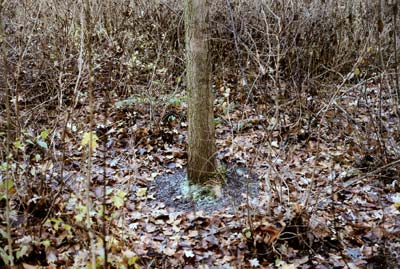
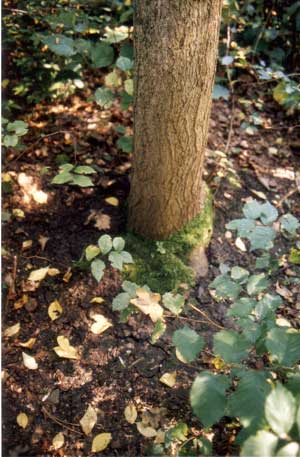
The Mygind Garden in Weimar is a branch of the Mygind Garden in Denmark.
Brit Sömmering, a student of Media Design and Architecture at the Bauhaus-Universität Weimar, began tending the "Mygind Garden"– outpost plant growth on the grounds of the Villa Haar on the basis of an agreement with the artist Till Krause in December 1998. She puts in three hours a week in the garden. This program of thorough care is the focal point and content of Till Krause's artistic work. A three-way relationship has developed involving the artist, the gardener and nature. Communication among the three is carried out through photography, letters and the garden work itself.
Katharina Hohmann (•) spoke with Brit Sömmering (:) in 1999.
• The Mygind Garden consists of a patch of ground measuring about
one square metre.
: It’s difficult to set a clear boundary ...
• But it is a small area, about the size of a table ...
: The main point is the tree. And the trunk. And the area immediately surrounding
it. What's important is always the spot I am working on, not the whole thing.
It's the work that is done on this tiny spot.
• It's about the working with found nature, a place selected by Till
Krause, not just any place ...
: He took considerable pains making his selection. But
those are things I can't discuss here because I can't explain them as well
as he can. My role in this is very small; my work becomes an art project in
his mind.
• So you're the one who does the work ...
: I take care of it, and because of the regularity of it through the weeks
and seasons I have
come to relate very closely
to it. It is something very personal.
• Devoting yourself to this kind of care is something very special,
different from taking care of people, who are biologically more closely related
to us. Is it more abstract?
: I think so, yes.
• It is a special form of life, this three hours of garden work. Viewed
from outside it seems senseless, devoid of meaning, but not in a negative
sense. It is a very special structure you've got yourself involved with.
: I had to develop a feeling for it, yes. But senseless? No. The sense lies
in the doing. In the care. When I think about it, it seems so very different
than when I'm actually doing it. I can let a lot of things go in my mind.
I can relax. I've never experienced spring as intensely as I have this year,
even though I grew up quite in touch with nature.
• You're tending to the tree right now?
: ... and the soil around the trunk.
• How do you tend them?
: With soft, rotating brushes. You hardly feel these brushes on your hand.
They clean the bark very gently and finely.
• I imagine you arriving here, fetching your tools and starting
to clean the trunk ...
: I usually take photographs when I get here – first selected details
or remarkable things, like a snail crawling up the trunk. I look for
changes. Then I remove the little things lying around on the ground close
to the trunk, like the many white blossoms that were lying like a carpet on
the ground.
• You give order to the chaos?
: Not order, no. It doesn't decrease. There is always a new cosmos that confronts
me. Sometimes I take note of how many centimetres I manage to clear, clean,
purify. It's hard to find the right term for that. Beneath it there are always
new layers and grains of sand, rotting parts of plants that disintegrate immediately.
Because I always photograph everything from so close up, it always seems larger
... but the point is not the clearing itself. I always start at the beginning,
but I notice the progression – the tree grows, and the bark has changed
a lot during the spring.
• How do you respond to the fact that passers-by cannot see either your
work or that of Till Krause. One doesn't see the Mygind Garden unless one
knows about it. The sign is quite a distance away from the work ...
: I don't think it would be the same if it were so easily accessible. Just
the fact that the tree does not stand out heightens the mystery, the magic
of this work.
• But isn't it a pity that the work doesn't speak out a bit more? It
isn't really accessible in any way. Your intensive care and your correspondence
with Till Krause keep it very private.
: It is something like the non-recurring moment for which one lives with such
concentrated intensity and devotes so much time to it. This tiny little piece
of nature that we take care of. The complexity of it is difficult to explain.
Perhaps a part of it will become clearer some day in an exhibition.