
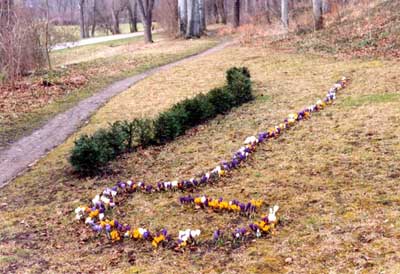
Thrown Ropes, since 1996
arbor vitae (Taxus baccata),
crocus (Crocus flavus et ruscus)
According to Hutchinson, the idea of using thrown rope originated in a methodology applied in the planting of English landscape gardens. In order to obtain as natural an arrangement of flowers (such as narcissuses, for example) as possible, the bulbs are thrown into the air and planted in the ground where they fall. Hutchinson introduced the rope to the process. With the rope, he describes a line that contrasts with the the random pattern formed by the thrown flower bulbs. The question arises as to the functions of lines in a garden. In most cases, they represent boundaries, between vegetable patches, flower beds and areas of grass or paths. Lines establish order among the different spatial subdivisions of the garden, emphasising their functional properties by creating borders.
While strict symmetrical arrangements of lines were preferred in French parks, curving lines were associated with the ideal of beauty in English landscape gardens. Garden- scenes were conceived as three-dimensional images that could be walked through. The Thrown Ropes can also be seen in this context. Hutchinson works like a painter with the tools of nature and with vegetation, a medium with which he has enjoyed a close relationship throughout his life. The work is significantly affected by the factor of time. The second line formed by the Thrown Ropes is visible only a few days each year – the brief period during which the crocuses bloom. During the rest of the year, visitors can observe the yew trees as they grow together, forming a low hedge.
Sabiene Ondracek