
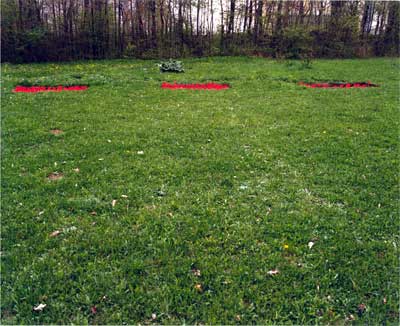
Tulpengräber, 1995/96, temporary
Tulips (Tulipa princeps, scarlet)
The Tulpengräber (tulip graves) occured to me when I recalled the legend of the innocent maidens. Banned to a far away place and condemned to death by magicians, in the following year they grew up once more in the shape of plants.
And in my thoughts I saw the red of the flowers bedded into a meadow of green.
Work with plants seemed to me to be sensually pleasing, like eating, drinking
or sex.
I chose the tulip more or less by chance; tulips often appear ugly, waxy in appearance, but perhaps precisely because of this, the colour of the blooms then really comes into its own. Whilst creating colour in the cycle of blossoming and fading, I had to discard the individuality of the plant. Only a union of hundreds of tulips could produce in its turn one colour with a life ot its own. The tulips were to grow out of the place where human bodies decay in graveyards. I wanted to recall my own transitoriness in advance.
For me, working with plants also means rejecting special effects. I have attempted to give the tulips a new significance, on the one hand as autonomous living beings, on the other hand by creating a situation which could not occur in this form without human intervention.
During the working process my own physical effort was necessary; without this, I would not have become quite so aware of the surprising effect of the work. After a longer period of waiting, a few months in the natural course of events, and observation of the seasonal changes, after a period of the plants’ survival underground which I coud not regulate, I finally saw the image before me, astonishingly enough, just as I had hoped.
On a few days in the months of April and May when the sun shone on them, the flowers glowed with a red so intense it hurt my eyes to look at them.
Marianne Buttstädt
(translation: Lucinda Rennison)